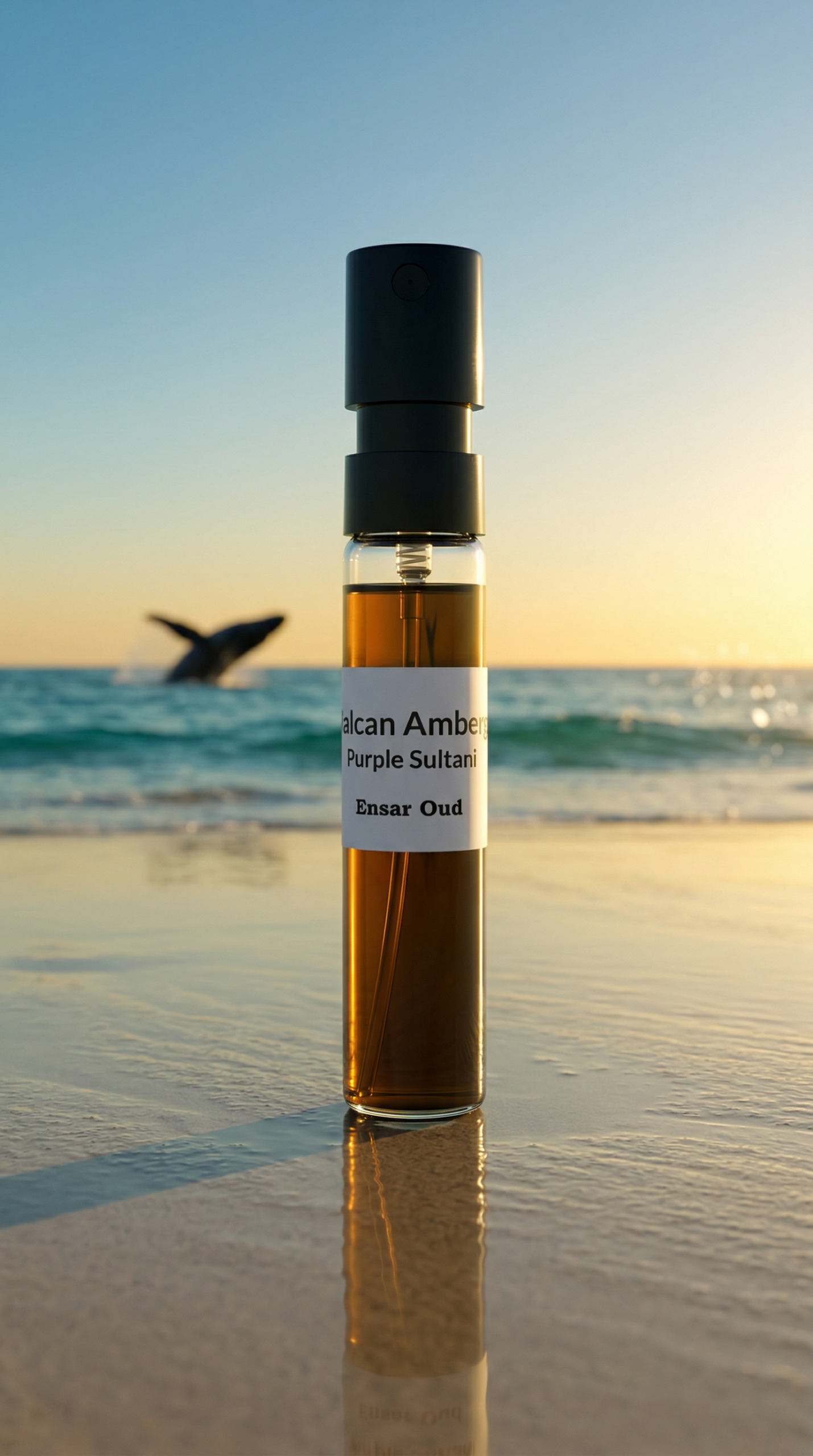
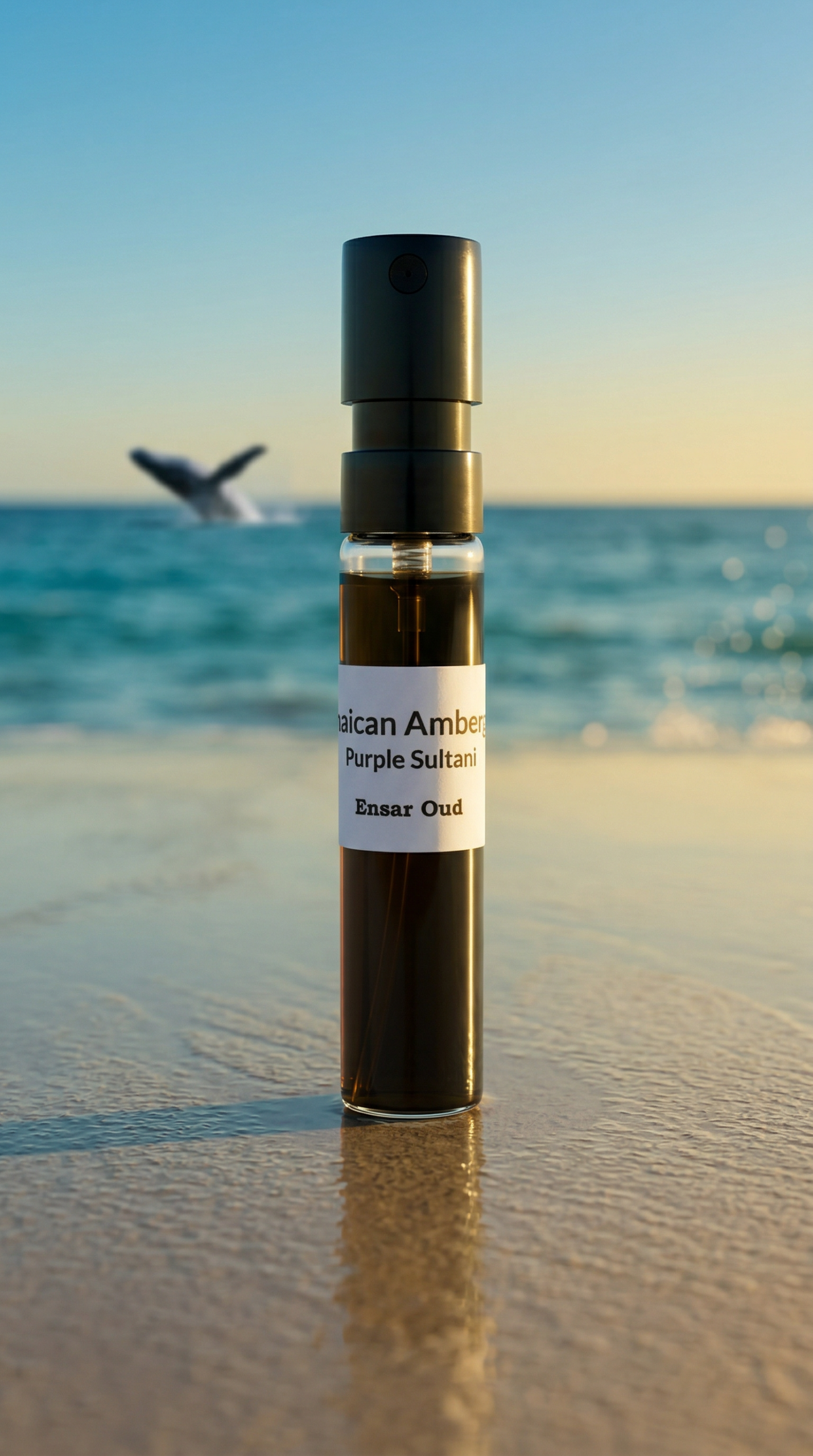
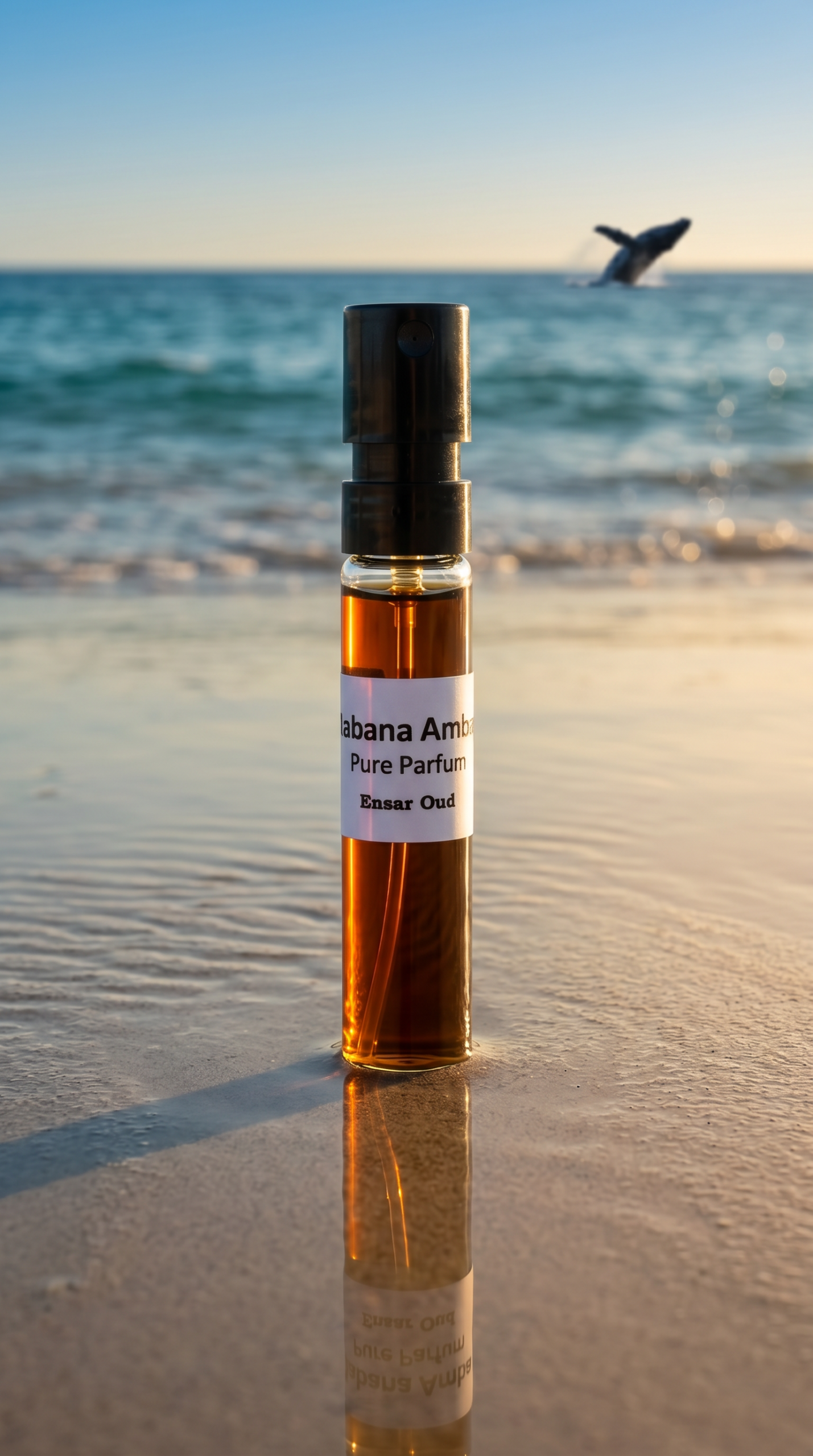
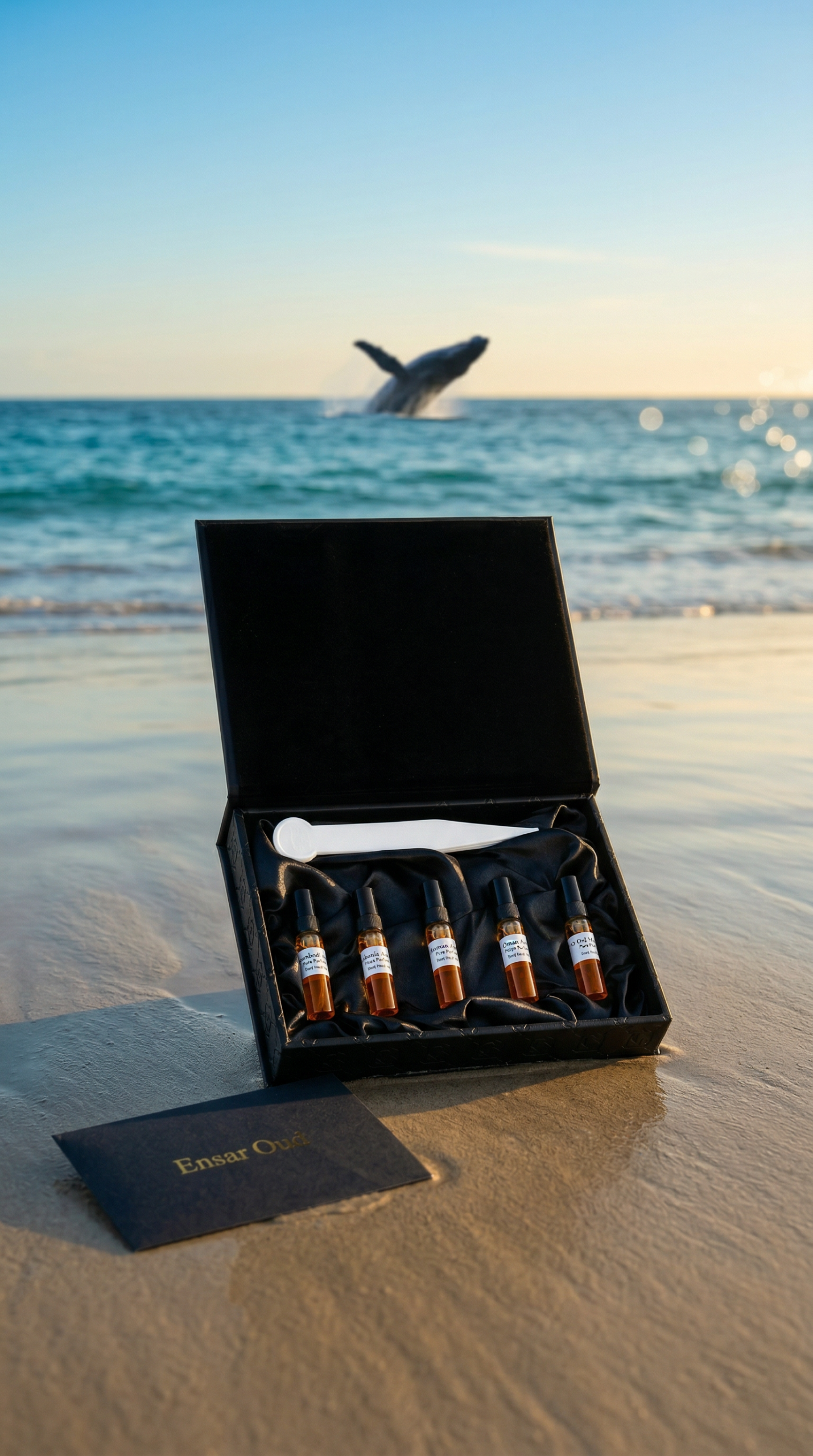
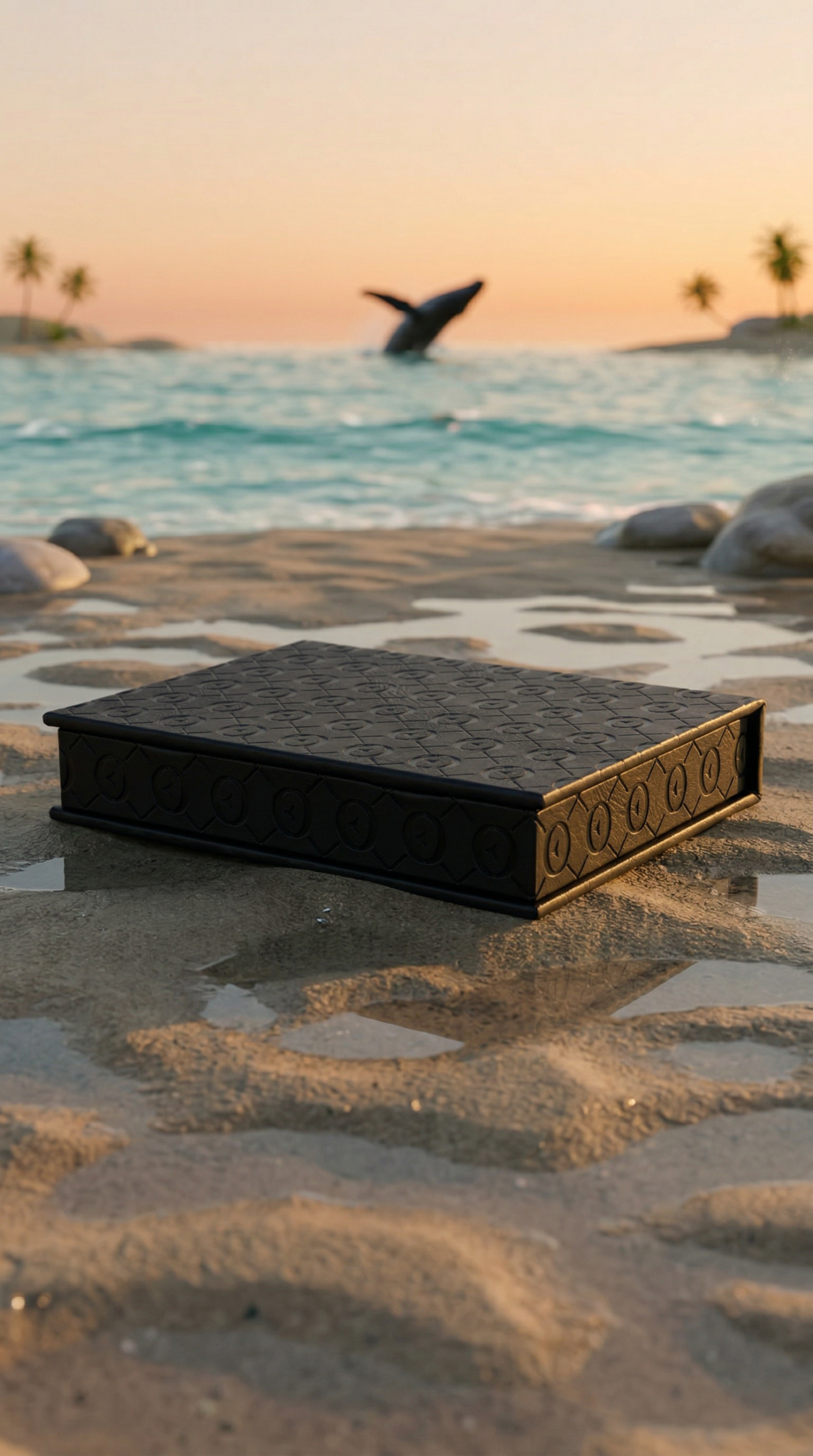
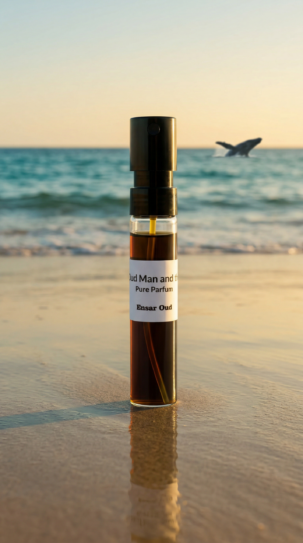
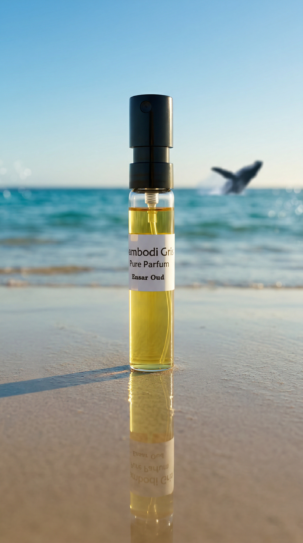
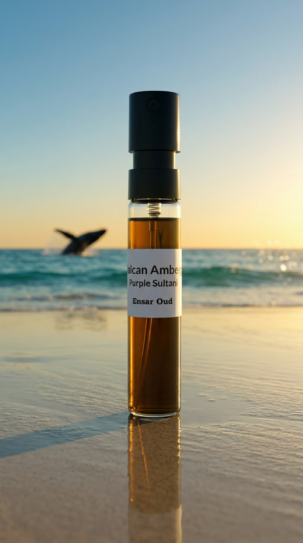
EO Amber Set
$399
What “Amber” Costs You
Ambergris forms inside sperm whales – a waxy, dark mass that spends years, sometimes decades, hardening in the open ocean before washing ashore. The stone that reaches a perfumer may be forty years old, or older. At auction, fine-grade ambergris trades above $40,000 per kilo. The global supply, across every coastline on earth, would not fill a bathtub.
This is why almost no one has smelled the real thing. What mainstream perfumery sells as “amber” is labdanum – a plant resin – dressed up with synthetic musks and vanillin. Pleasant. Nothing to do with ambergris.
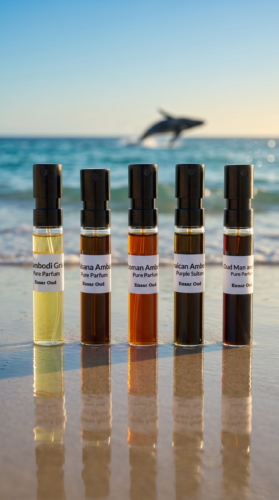
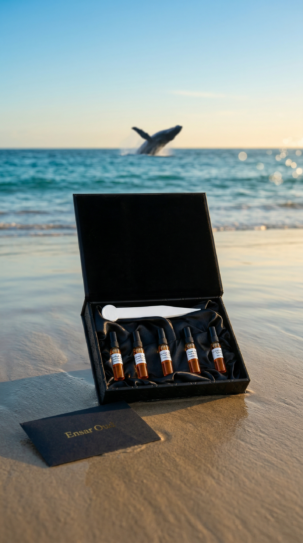
The difference matters. True ambergris doesn’t add a note to a perfume. It restructures everything around it. It amplifies the diffusion of whatever it touches, binds volatility to depth, and extends the sillage of a composition for hours beyond what the other aromatics could achieve on their own. The EO Amber Set is five compositions that show exactly what it does – each time with a different oud, a different intention, a different result.
What Ambergris Actually Does
Chemically, ambergris is rich in ambrein, a triterpene alcohol that oxidizes over decades into a range of compounds – ambrinol, ambroxide, dihydroambeinolide – each contributing facets that shift from oceanic and mineral to warm, dry, and skin-close. The longer the piece has oxidized in sea and sun, the deeper and more complex those facets become. A forty-year-old piece smells nothing like a fresh one. That oxidation cannot be synthesized: the synthetic substitute ambroxan reproduces one facet of one compound and leaves the rest out entirely.
Every perfume in this set uses real ambergris. The quality differs between compositions, because so does what each composition demands of it.
Ambergris at Work
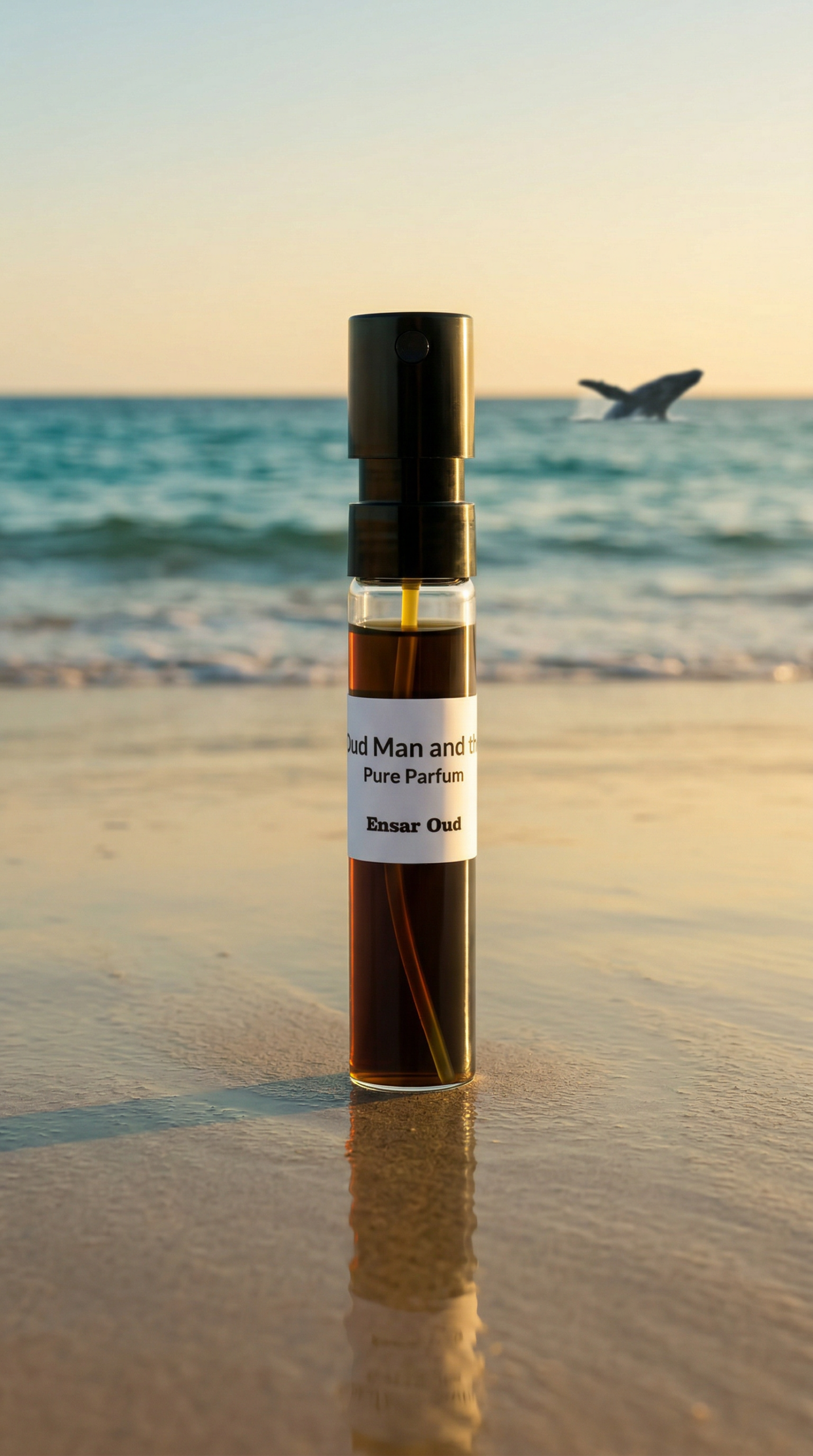
The Oud Man and the Sea: Aged Pekanbaru, Sumatran, and Malaysian ouds form the core – three distinct floral-resinous profiles fused into a single dense base. On their own, these ouds are complex enough to fill a composition. The ambergris here doesn’t decorate them; it opens them. The terpene compounds in aged ambergris interact with the sesquiterpenes in oud resin, loosening the oud’s natural density and projecting it further off skin – the reason the tobacco, osmanthus, Bengali pepper, and dark cacao that spiral through the composition reach you before the oud itself does. The mitti attar grounds the whole structure with a mineral, petrichor quality, and Japanese rose otto and Mongolian musk add diffusion without pulling the character toward florals. Dark, maritime, and unrepeatable.
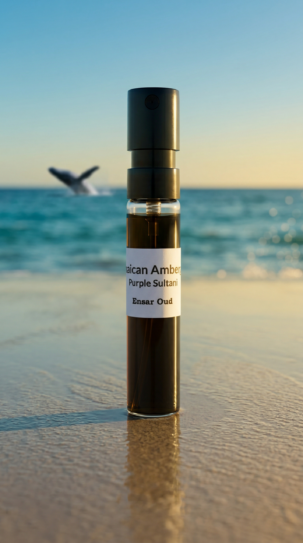
Jamaican Ambergris: The ambergris in this bottle spent forty years inside an attar in a royal treasury – not as an aging experiment, but as the normal fate of rare materials in the courts that once considered them currency. That Aoudh al Azraq, already dense with amber that had permeated its resin over decades, forms the aromatic spine of the composition. On first contact, it’s the only thing in the bottle – sandy, oceanic, with the dense salinity of fine grey stone. Then jasmine sambac and frangipani come through, their indolic richness amplified by the ambergris rather than competing with it. Bourbon vanilla and massoia bark add a creamy coconut-milk warmth that coats the base without sweetening it into dessert territory. This is the closest a perfume comes to studying the ingredient itself.
Ottoman Ambergris: The Assam Sultan oud anchoring this composition is vintage agallocha – the oldest Hindi oud in the EO atelier, chosen specifically because the ouds that went into Ottoman ghalias would have been aged Indian distillations, not the processed generic grade now filling the market. Vintage Myitkyina, Borneo agarwood resin, Sumatran oud, and proprietary Maroke oud layer over it – each with a distinct character that would normally compete for dominance. The ambergris from Sultan Qaboos’ personal collection acts on this oud stack the way it acts on all complex bases: it unifies. What would otherwise be five separate oud profiles becomes a single opulent body. Jasmine juhi, blue lotus, hyacinth, mimosa, and cassie bloom through that base without lifting it – the florals are present but the oud absorbs their sweetness rather than being displaced by it. Black tea and oakmoss add a dry, tannic counterweight. This is not a light fragrance. It’s what royal perfumery actually smelled like.
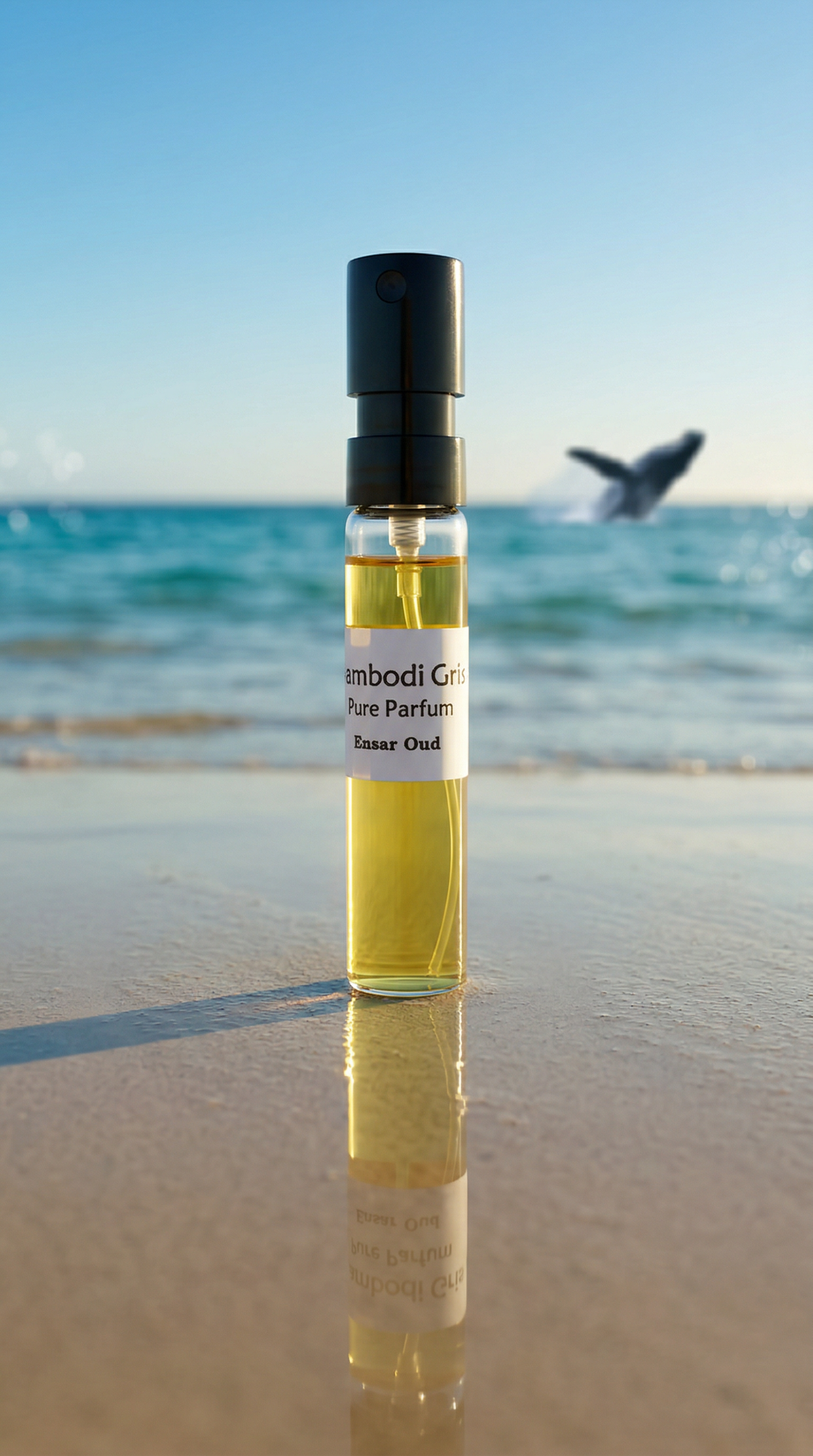
Kambodi Gris: The Cambodian oud here was distilled in-house from wild-harvested crassna and steeped in Tonkin musk before the composition was assembled – so when the ambergris meets it, it’s not meeting raw oud but oud that has already been transformed by one of the rarest musks in existence. The ambergris does something different in this context than in Jamaican or Ottoman. Instead of projecting outward or anchoring inward, it extends upward – brightening the lavender and basil top notes, making the apple facet crisper, turning the “Gris” character (that cool, mineral, slightly metallic quality) sharper and more sustained. Cedar and fir push from the opposite direction, keeping the volatility grounded. Frankincense and mimosa fill the middle. What emerges is neither an oud perfume nor a lavender perfume – it’s a hybrid that behaves like neither, carrying both the sharpness and the resinous depth into a single coherent identity.
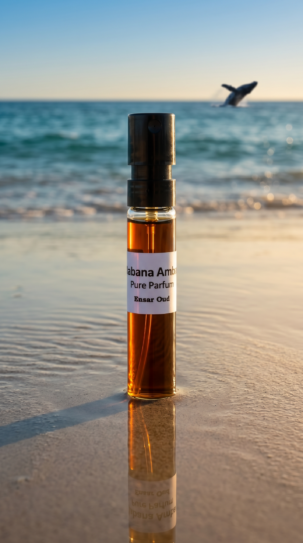
Habana Ambar: Tobacco and ambergris are two aromatics with the same problem: too much of either collapses the composition around it. Both are dominant. Both suppress other materials when overdosed. The formula here works because neither is used as a feature note – each functions as a structural element that carries the others. The tobacco, extracted from sun-dried Cuban-style leaves, arrives with a salty marine quality that is lush and fresh before it becomes dark – more cured than smoked, closer to dried hay laced with brine than to anything acrid. The mango and Siberian fir top notes are vivid, juicy, and short-lived. Then the ambergris takes over underneath the tobacco, adding the oceanic salinity that makes the whole composition feel lived-in rather than constructed. Sandalwood and rose absolute provide a creamy, grounding warmth in the drydown. The final skin impression is amber and tobacco without the weight of either.
The Oud Does the Rest
Genuine ambergris at perfumery grade is allocated in grams, not kilograms. A single composition using it in real material weight, not trace amounts, represents a cost that most houses never absorb. This set contains five such compositions, each composed around a different ambergris source and a different oud.
At $399, there is no better introduction to what ambergris actually is – and nothing else available that shows you this much of it at once.
Reviews of the EO Amber Set…
I’m speechless as you expect me to be, I wrote the following about the 4 perfumes. Did not review the samples yet. Thank you for taking me 50 years back to my childhood when both of my grandmothers used to put the real forest aged Oud oil , Deer Musk , Ambergris. You took me in a time machine to those lovely times. It’s good that I explored your products as it’s not so often that I find a perfume that shakes me to the core!
I leave you with my review:
As a devoted student of perfumery for many years, I have learned that true mastery lies not in taming a material, but in exalting it. Ensar Oud’s recent quartet of ambergris-centric compositions is not merely a collection; it is a masterclass in olfactive philosophy. Each fragrance does not just contain ambergris—it is built as an ancient Cathedral or a Mosque around it, revealing a different facet of this sacred, sea-born treasure. This is perfumery at its most intellectually satisfying and sensorially profound.
Jamaican Ambergris: The Elemental Truth
In a world saturated with synthetic “amber” accords, this is a revelation. It is, quite simply, the closest one can come to holding a decades-aged, sea-polished piece of raw white ambergris in the palm of your hand. The opening is a shock of truth: dense, briny, and breathtakingly oceanic, with a distinct saline, sandy texture that feels alive. It carries the electric charge of the sea. Then, the genius of the composition reveals itself. The ambergris doesn’t remain a solitary note; it becomes a prism through which other precious materials ignite. A buttery jasmine absolute lifts from within, glowing resins begin to pulse, and a profound, sinking-grade oud turns the entire structure a diffuse, regal purple. This is not a perfume that mimics ambergris; it is ambergris, given voice and volume. It’s the Grail that perfumers chase and almost never, ever capture.
Ottoman Ambergris: A Legacy, Distilled
If Jamaican is the material’s soul, Ottoman is its history. This is a fragrance of staggering cultural depth, inhaling the amber-scented air of a sultan’s palace, where fragrance was not an accessory but a ritual of identity. The ambergris here does not announce itself as a single note; it is the very atmosphere, the hum of reverence in a sacred space. An incredibly high-quality vintage Hindi oud provides a leathery, hay-like, noble foundation, upon which florals are layered not as a bouquet, but with the architectural precision of a Sinan masterpiece. It is intricate and deeply complex, a scent you do not “get” on a first encounter. Instead, it demands and rewards contemplation. Each return visit reveals another corridor, a hidden garden, a new layer of its opulent, slow-unfolding narrative. It is a masterpiece of heritage, worn on the skin.
Kambodi Gris: The Architecture of Tension
Here, the focus shifts from raw beauty to breathtaking structural design. Kambodi Gris is a study in controlled tension, a perfectly engineered bridge between two worlds. A precision-distilled Cambodian oud provides a sharp, lifted, almost ozonic framework—clean, bright, and piercingly elegant. Into this space, the ambergris intervenes not as a softener, but as a master harmonizer. It binds the sheer volatility of the top notes to a profound, resinous depth, transforming contrast into a new form of cohesion. The result is a fragrance of remarkable intelligence. It feels taut, composed, and modern, like inhabiting a skyscraper made of glass and ancient, fossilized wood. It’s a tightrope walk, executed with flawless grace.
Habana Ambar: Warmth, Profoundly Redefined
Habana Ambar is a masterclass in restraint and texture, proving that a warm, comforting fragrance requires no descent into simple sweetness. It redefines indulgence as something darker, more intellectual, and infinitely more compelling. The ambergris is woven through a tapestry of shadowy, almost tobacco-like accords and deep, whispering resins. There is a gentle smokiness here, a quiet, smoldering power that feels grounded and profound. It is refined and supremely sophisticated—the olfactory equivalent of a knowing silence in a room full of noise. This is not warmth for the sake of ease; it is the warmth of a deep, textured, and quietly powerful soul. It stays close, but its presence is absolute.
Conclusion
To experience these four works is to witness a perfumer operating at the zenith of his art. Ensar has not simply released four ambergris fragrances; he has delivered a definitive thesis on the material itself—from its raw, elemental truth and its imperial grandeur to its structural brilliance and its textured, soulful warmth. This collection is an incomparable gift to the true connoisseur, a standard against which all future ambergris compositions will inevitably be measured.
Related products
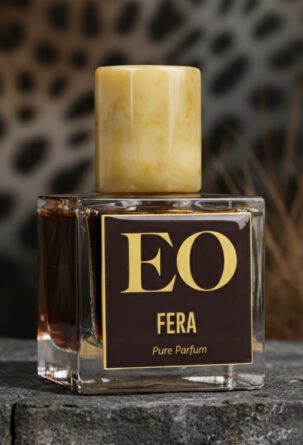
Fera is the kind of fragrance the mainstream tries to outlaw from its monoculture because…
This product has multiple variants. The options may be chosen on the product page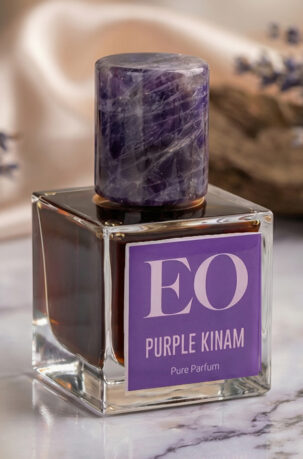
Extragalactic purple fruits and flowers decked out for…
This product has multiple variants. The options may be chosen on the product page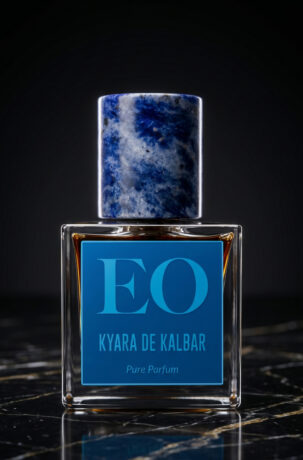
Ships by 15 September.
This product has multiple variants. The options may be chosen on the product page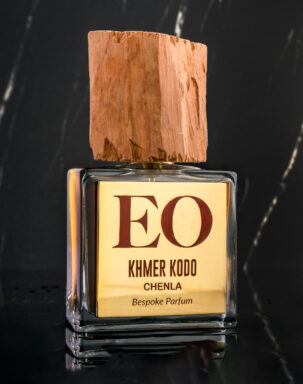
The way the Cambodian rough siphons through the…
This product has multiple variants. The options may be chosen on the product page